Google Ads vs. Prime Video and CTV Ads
By Ian McCue ·
You already know Google Ads. Someone types "emergency plumber" or "HVAC near me" into Google, your ad shows up, and you pay for the click. It works because you're catching people at the exact moment they're ready to buy.
But there's a catch, and it's a big one. You're bidding against every competitor in your area for that same click. The more of them there are, the more each click costs. And the second you stop paying, you disappear. Google Ads is rent, not equity.
Prime Video and other connected TV (CTV) ads play a different game. Your commercial runs full screen, sound on, in the middle of a show someone actually chose to watch. It isn't about winning a click today. It's about becoming the name people already trust by the time they need you.
This is the honest comparison. Where each one wins, where each one falls short, and why the smart move for most local businesses isn't Google or streaming TV. It's both.
What Google Ads is great at
Let's give Google its due, because it earns it. Google Ads is the best tool ever built for catching demand that already exists. The person with a burst pipe isn't relaxing on the couch. They're on their phone, typing fast, ready to call the first business that looks legit. A search ad puts you in front of that person the second their wallet is open. Nothing builds that kind of timing better.
It's measurable, too. You can see the clicks, the calls, and the form fills, and tie them back to the keyword that drove them. For a business that lives on this week's leads, that feedback loop is hard to give up.
Here's the part the sales rep glosses over. It's an auction. You're not paying a fixed price for attention, you're outbidding everyone else who wants the same customer. In crowded categories like home services, legal, and anything with "near me" attached, those clicks get expensive, and they keep climbing as more businesses pile in. You can win the click and still lose the job to a name the customer trusts more. And the day your card stops working, your presence is gone. You're renting attention by the click, and the rent goes up.
What Prime Video and CTV ads are great at
Streaming TV isn't trying to win the click. It's trying to win the memory.
Your ad runs on premium content like Prime Video, full screen, sound on, and it can't be skipped. The viewer leaned back, picked a show, and your 30-second commercial plays as part of that experience. That's a different kind of attention than a muted clip someone thumbs past in a feed. It looks like a real TV commercial because it is one, and that "as seen on TV" credibility still carries weight.
It's targeted, not sprayed. You aim at the right households using Amazon's audience data and ZIP codes, so you're paying to reach people who could actually become customers, not the whole country. And it's affordable in a way TV never used to be. Here's what that looks like on our platform.
Streaming TV (Trusted TV platform data)
Budget: $25/day (median). Views per four-week campaign: about 9,100. Unique people reached: about 5,900. All-in CPM: about $42.50 per 1,000 views, which already covers the commercial we make for free and the campaign management. Median time from signing up to a live campaign: about 41 minutes. Typical targeting: a 10-mile ZIP-code radius. Every view is a non-skippable, full-screen ad built for attention, not a quick click.
Figures are approximate, based on Trusted TV platform data as of May 2026. Streaming figures are medians.
Notice what isn't on that list: a cost per click. Streaming TV isn't a click machine, and pretending otherwise would be dishonest. Its job is to make you familiar, so that later, when someone is finally ready to act, you're the name they already know. For the mechanics of how the ads run, see how Prime Video ads work.
The HVAC example: why she clicks the name she knows
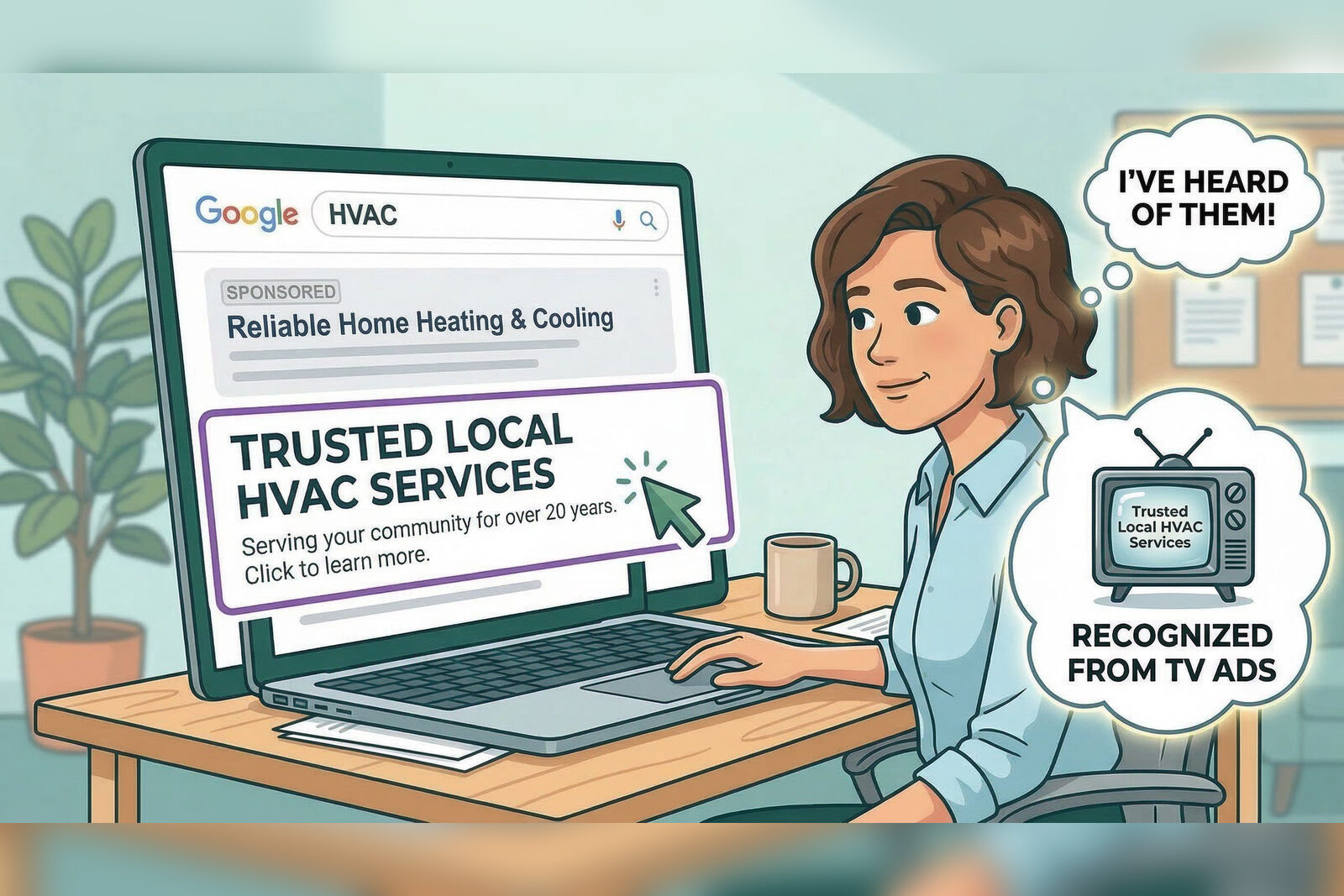
Look at the illustration at the top of this page. A homeowner is searching Google for HVAC. A few results come up. She clicks the one she recognizes, thinking "I've heard of them," because she's been seeing their commercial on TV. That's the whole idea in one picture.
Say you run an HVAC company. In spring, that homeowner doesn't need you, and no amount of Google bidding changes that, because she isn't searching yet. But she's watching TV. Your commercial shows up between episodes, a few times, over a few weeks. You become a familiar name.
Then July hits, the AC dies, and she grabs her phone and types "HVAC near me." Now the search ad matters. And when your name shows up next to three companies she's never heard of, she clicks yours. The TV ads didn't replace the Google click. They're the reason the Google click landed on you.
It's not Google or streaming TV. It's both.
The either/or framing is a trap. These two channels aren't competitors. They're two halves of the same job. Streaming TV builds the demand and the trust. Google captures it at the moment of intent. One makes people want you and remember you. The other is there to close when they go looking.
Run only Google and you're paying premium auction prices to compete on a name nobody recognizes. Run only TV and you're building awareness with no net underneath to catch people the day they're ready. Put them together and each one props up the other.
There's a compounding effect, too. When people already know your name, more of them search for you directly, and they're likelier to click your ad over a stranger's when they do. Familiarity makes every other dollar you spend, including your Google budget, work a little harder. You're not just buying views on TV. You're lowering the difficulty of every click that comes after.
How long before streaming TV starts working?
Set your expectations right, because this is where people get it wrong. Google can show results in days, because you're skimming demand that already exists. Streaming TV is building something, and building takes a little time.
We tell every business the same thing: run for at least four to six weeks before you judge it. That's enough repetition for your name to actually stick with the households you're reaching. By the end of that window you should be seeing the difference, more branded searches, more "I saw you on TV," more inbound that doesn't trace back to a single click.
If you're not, that isn't a reason to quit. It's a signal to experiment. Try a new edit of the video, tighten the targeting, or sharpen the offer. The channel works. The lever is almost always the creative or the audience, not the medium.
When to lean on each
Having run a lot of local campaigns, here's the honest split.
Reach for Google when:
- Someone is actively searching for what you sell right now.
- You can profitably pay for a click and have the capacity to handle the lead today.
- You need bottom-of-funnel capture this week, not brand-building over a quarter.
Reach for Prime Video and CTV when:
- You want to become a recognized, trusted name in a specific local area.
- You want full attention: a real 30-second commercial that gets watched start to finish.
- You want durable awareness that makes your search ads, referrals, and website all convert better.
- You don't have a video yet. We make a real commercial for you, for free, and most businesses are live in about 41 minutes.
The businesses that win usually don't choose. They use TV to become known and Google to get found, and they let each one do what it's best at. If you want the full picture on the streaming side, start with our guide to streaming TV advertising for small business, then see exactly what streaming TV advertising costs. And if you're weighing TV against social specifically, we ran streaming TV against Facebook ads and wrote up what we saw.
Want to see what your commercial would look like before spending a dollar? Make a free video and you can be live in about 41 minutes. No production invoice, no agency, no long-term contract. Build the trust on TV, and let Google catch the people who are finally ready.
FAQ
Should I use Google Ads or Prime Video and CTV ads?
Both, if you can. They do different jobs. Google catches people who are already searching and ready to buy. Prime Video and CTV ads make your brand familiar and trusted before that moment arrives, so more of those searches go to you. Run only one and you are doing half the job.
Are Prime Video ads cheaper than Google Ads?
They are priced differently, so it is not a straight comparison. On Trusted TV the all-in CPM averages about $42.50 per 1,000 views at a median budget of about $25 a day, and that includes the commercial we make for free and the campaign management. Google Ads is a pay-per-click auction, so what you pay depends on your industry and how many competitors are bidding on the same searches. In competitive local categories those clicks get expensive.
How long until streaming TV ads start working?
Give it at least four to six weeks. Streaming TV builds familiarity through repetition, so it is not an overnight, click-today channel. By the end of that window you should see the difference. If you do not, it is usually a signal to test a new video edit or tighten your targeting, not a reason to quit the channel.
Can streaming TV ads make my Google Ads work better?
Yes. When people already recognize your name, more of them search for you directly, and more of them click your ad over a competitor they have never heard of. Familiarity built on TV makes the click you pay for on Google more likely to land on you. That is exactly what the homeowner in the example above is doing.
Do I need a video to advertise on Prime Video?
No. You need a commercial, but you do not need to arrive with one. Trusted TV makes your video for free when you sign up, and the median business goes from signup to a live campaign in about 41 minutes.